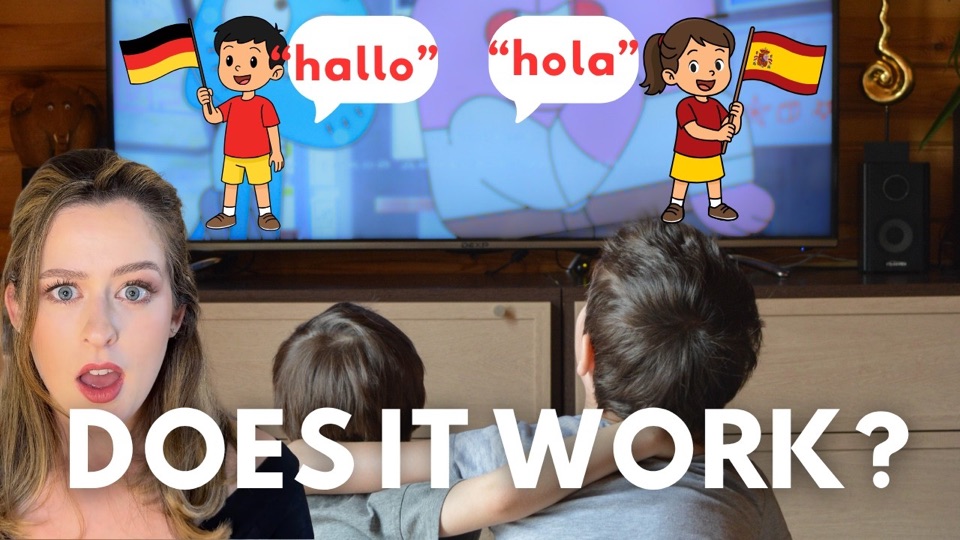
Do second children talk later? What 6,163 Norwegian toddlers showed
A 2025 Norwegian study found later-born toddlers had slightly smaller vocabularies, third-borns lowest, with the pattern curving back up in big families. The gaps were small, and the ‘big sisters help more’ headline is shakier than it sounds.

Watch the video: Do Second Children Really Talk Later? (What 6,000 Children Showed) · Subscribe to Mum Science
Second children rarely get the running commentary the first one got. With my son, every nappy change came with a full narration. With my daughter, who is one, I talk to her constantly when it's just the two of us. But when my nearly-three-year-old is in the room, I know I talk to her less. He needs a lot of attention, and I don't want him to feel pushed out because I'm only chatting to the baby. It's a hard balance to keep everyone happy.
So when a large Norwegian study asked whether later-born children really do have smaller vocabularies, I wanted to read it properly. The answer is yes, slightly, on average. But the pattern was not a straight line, older siblings turned out to be part of the explanation, and the headline about big sisters helping more is much shakier than it sounds.
What did the study actually do?
The paper was published in Child Development in 2025 by Audun Rosslund and colleagues at the University of Oslo. Families were picked at random from Norway's birth registry, and the final sample was 6,163 children aged 8 to 36 months. Parents worked through a long checklist and ticked the words their child could say and, for the younger ones, the words they could understand. The data were collected back in 2008 and 2009.
Each child's score became a percentile. Imagine lining up 100 children of the same age and sex and seeing where this child stands: the 50th percentile is the middle. The main analyses were pre-registered, which means the researchers wrote down what they would test before they looked, and that is always a good sign.
Do later-born children have smaller vocabularies?
The first finding is the one you would expect. The further down the family, the fewer words, but the drop was small and it did not keep going. Reading off the authors' chart for words said:
- firstborns averaged around the 52nd percentile
- second-borns around the 48th
- third-borns around the 44th, the lowest of any group
- fourth and fifth-borns were back near the 48th or 49th
- sixth and seventh-borns were near the 58th
A curve fitted the data significantly better than a straight line, hence the U-shape, and words understood looked similar. Two things are worth holding on to. This is vocabulary compared with same-age children, not the age first words arrived. And the groups were very uneven: there were 2,471 firstborns but only 32 children who were sixth-born or later. So on average, first and third children sat a handful of places apart. That's real, but it's hardly a different league, and in every group some children were right at the top and others at the bottom. The big comeback for the youngest in large families rests on roughly one classroom's worth of children. As a former teacher, that is probably the one time I'd ask for a bigger class.
Are big sisters better language teachers than big brothers?
The researchers tested this head-on, because an earlier French study had found that the sibling dip came from older brothers. For second, third and fourth-borns, having an older sister rather than an older brother made no significant difference. Neither did the age gap, apart from one fourth-born result the authors say to treat with caution.
To explain the U-shape, they built a child-to-caregiver ratio, a bit like a nursery staff ratio. Two parents and a toddler is one child to two caregivers. Add a four-year-old and it's two to two. The new idea is that an older sibling switches sides and counts as a caregiver from a certain age. Nobody knows what that age is, so, using two-parent homes, they tried 400 combinations of cut-offs for brothers and sisters and kept the best fit. For words said, the best fit counted sisters from 13½ and brothers from 14½. For words understood, it was 9½ and 12½.
This ratio explained vocabulary better than birth order alone, and it explains the U. Around 4% of second-borns' older siblings were old enough to count as helpers, against over a third of fifth-borns' siblings. So are big sisters better? Compared head-on, no. The sister difference only shows up in which cut-off age fitted best, which is much softer evidence. And the helpers here are mostly teenagers, not the toddler banging a drum next to the baby. I did wonder whether my son counts as a caregiver to his sister. I'm fairly sure he does not.
The honest limitations
This is a snapshot of families, not an experiment. More little ones per grown-up went with slightly smaller vocabularies, but the study can't show that siblings caused it. The ‘caregiver’ label was attached to a birthday: nobody checked whether those teenagers actually looked after the babies or talked to them, and the authors say that needs measuring next. To be fair, it's a big, randomly invited sample, and their checks suggest parents of children close in age weren't simply misreporting. But it is still parents ticking boxes, in one country, with children who regularly heard another language at home left out. And the ratio was chosen as the best of 400 versions of the same data, which flatters the winner. The authors themselves call that part exploratory.
Why would a second child hear fewer words?
The obvious explanation is that grown-up attention gets shared. A small American study published in 2026 recorded 26 families for whole days. Babies aged 6 to 12 months who had an older sibling had about half as much speech aimed at them, but only when the sibling was in the room. That is a small sample, and I could only read the abstract, so hold it lightly. It does match my own living room, though.
Siblings may give something back, too. A 2025 study from Zurich found that babies aged 8 to 20 months, in Switzerland and in the Peruvian Amazon, paid more attention to recordings of children chatting to each other than to adults doing the same. That was about 60 babies per group, in a lab, and paying attention is not the same as learning. Still, it fits with the idea that older siblings are part of a baby's language world, not just competition for it. If you want more on how toddlers pick up words, I've written about what 2,500 toddlers' eye movements reveal about language learning.
What this means if you have more than one child
If you've got a second or a third and you worry they're getting the leftovers, please don't. The differences here were small, literally a couple of places in the line, and plenty of later-born children were near the top. Less one-to-one chat with a second-born is not a parenting failure. It is just numbers: the same number of grown-ups, with more small children all wanting your attention.
A few low-effort things that fit real life:
- Find a few minutes of one-to-one chat. It doesn't need to be special. The NHS suggests talking about what you're doing as you feed them or change their nappy. That back-and-forth is the serve and return that matters so much.
- Let the big ones join in. Reading to the baby, chatting nonsense at them, getting them to talk to each other. My daughter loves listening to her big brother, and the conversations between them are lovely to watch.
- Don't keep score. Comparing a second child's word count with your firstborn's at the same age tells you very little on its own.
If you are ever worried about your child's talking, the NHS says to speak to your GP or health visitor, and in many areas you can contact a speech and language therapist yourself. For what it's worth, I was a third child, and I don't think my vocabulary has been particularly stunted. More small children per grown-up means slightly fewer words on average. But eventually, the older ones move from the children's column into the helpers' column.
Questions parents ask
Is it normal for a second child to talk later than the first?
Small differences are common and usually nothing to worry about. In a study of 6,163 Norwegian toddlers, later-borns had slightly smaller vocabularies on average, but the gaps were only a few percentile places and many later-born children scored near the top. If your child isn't using words you'd expect for their age, or you're worried, speak to your GP or health visitor.
What is a child-to-caregiver ratio in language research?
It counts how many small children there are in a household for each person old enough to look after them, a bit like a nursery staff ratio. In the Norwegian study, older siblings were counted as caregivers once they reached a certain age, mostly early teens. This ratio explained toddlers' vocabulary better than birth order alone, although the cut-off ages were chosen as the best fit to the data.
Do older siblings help a baby learn to talk?
Possibly, once they are older. In the Norwegian data, siblings seemed to shift from competing for attention to adding to it around the early teens. Separately, a small lab study found babies paid more attention to recordings of children chatting than adults chatting. Neither study measured siblings actually talking to babies, so treat this as a promising idea rather than a proven effect.
Does having a big sister rather than a big brother make a difference to speech?
Not clearly. When the Norwegian researchers compared children with an older sister against children with an older brother directly, there was no significant difference. Sisters only came out ahead in which cut-off age fitted the data best, which is much weaker evidence. An earlier French study had pointed to older brothers, so research on this keeps going back and forth.
References
- Rosslund, A., Kartushina, N., Serres, N., & Mayor, J. (2025). Early vocabulary acquisition: From birth order effect to child-to-caregiver ratio. Child Development, 96(4), 1343–1353. doi.org/10.1111/cdev.14251 (accepted manuscript: doi.org/10.31234/osf.io/nk4g7_v2)
- Galindo, M., & Montag, J. L. (2026). The role of siblings on infant language exposure in daylong audio recordings. Developmental Science, 29(4), e70222. doi.org/10.1111/desc.70222
- Schick, J., Daum, M. M., & Stoll, S. (2025). Input to the language learning infant: The impact of other children. Developmental Science, 28(5), e70045. doi.org/10.1111/desc.70045
- NHS. Help your baby learn to talk. nhs.uk/baby/babys-development/play-and-learning/help-your-baby-learn-to-talk/