Eye contact with your baby: do chimpanzee mothers do it too?
Researchers filmed 10 chimpanzee and 10 human mother-baby pairs across the first year. Both species held each other's gaze, but the humans did it more, and the pattern over time was different.

Watch the video: The Thing Human Mothers Do More Than Any Other Primate · Subscribe to Mum Science
You know the stare. You pick up a baby, they look at you, you look back, and then neither of you moves. It can go on for ages. I'm not naturally a big eye-contact person (when I first met my husband I could barely look him in the eye, which is a story for another day), but with babies it just happens.
With my firstborn we even had a little rule: never be the first to look away. He was learning so much in those moments about faces, about back-and-forth, about who was there for him, that I wanted him to be the one to break it. So when I came across a study that filmed chimpanzee mothers and human mothers gazing at their babies across the whole first year, I had to read it. The question it asks is lovely: is that moment ours, or is it older than us?
What did the study actually do?
The paper came out in 2023 in Philosophical Transactions of the Royal Society B, led by Federica Amici, and it's open access, so anyone can read it. The team compared ten human mother-baby pairs from two cities in Germany with ten chimpanzee mother-baby pairs living in zoos. They filmed each pair when the babies were one month, six months and twelve months old.
That design matters. Rather than taking one snapshot of different babies at different ages, it follows the same pairs through their first year. The researchers then coded who was looking at whom, when, for how long, and what was going on at the time: feeding, grooming and so on.
The thing they were measuring is called mutual gaze. It simply means two of you looking at each other's faces at the same time. It's one of the earliest genuinely two-way things a human baby does, and a lot of later social development is built on top of it.
Why does it matter that the mothers were WEIRD?
The authors are careful about one piece of context, and I think it's the most important line in the paper. The human mothers came from what researchers call a WEIRD society: Western, educated, industrialised, rich and democratic. In those societies, long face-to-face gazes between mother and baby are especially common.
That isn't true everywhere. In plenty of other cultures babies are carried more, held facing outwards more, and looked at face-on less, and those children develop perfectly well. So when this study says 'humans', it really means one particular slice of humans. If your family carries a lot and faces less, you're well within the normal range of how our species raises children.
What did they find?
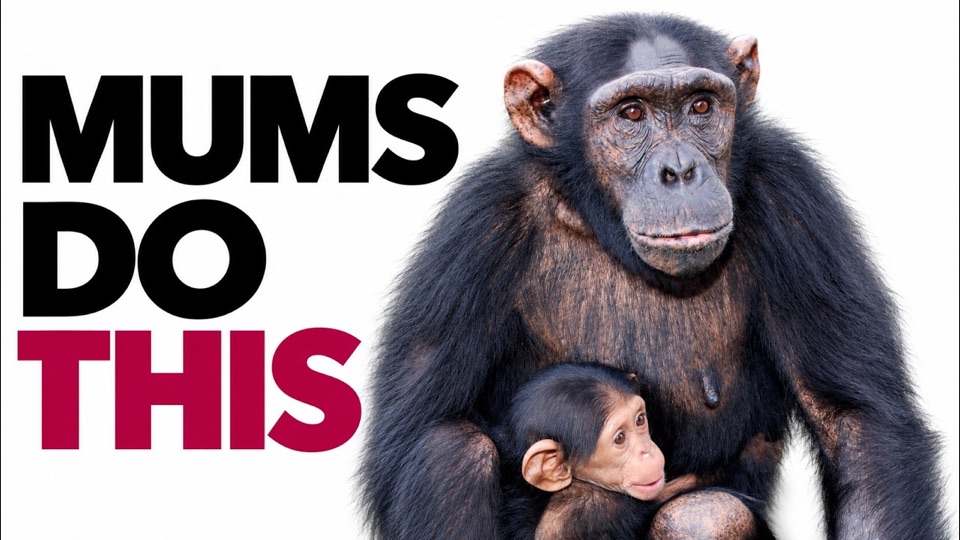
The headline is that both species did it. Chimp mothers and their babies looked into each other's faces too, all the way through the first year. So that locked-on look isn't something humans invented. It's older than us, which I find quite lovely.
There were differences, though:
- Humans held it for longer. Mutual gazes lasted longer in the human pairs than in the chimpanzee pairs.
- Humans did it more often. The gazes were also more frequent.
- The pattern over time was different. In humans, mutual gaze peaked at around six months and then came down. In chimpanzees it kept rising steadily with age across the first year.
- In both species, the longest looks came during care. Gazes were longer during caring and grooming, and during feeding.
That last point is the one I keep coming back to. The looking wasn't a separate activity squeezed in around the business of looking after a baby. It was woven into it, in both species.
Why might human babies get more eye contact?
The study doesn't test this, but it's the reason comparative work like this gets done. The leading idea is about physical distance. A chimpanzee baby can cling to its mother. Ours can't, so human babies get put down far more often: on a blanket, in a cot, in a bouncer. One argument is that face-to-face looking and vocal back-and-forth evolved partly to hold the connection across that gap, keeping mother and baby linked even when they aren't touching.
It's a plausible story, and it fits neatly with what we know about serve and return, the little exchanges of looks, sounds and responses that build a young child's brain. But it is a story, not a finding of this paper, and I'd hold it lightly.
The honest limitations
This is a small study. Ten pairs per species is twenty pairs in total, which is fewer children than you'd find in a single primary school class. That alone means we should be cautious about saying what chimpanzees or humans do in general.
The chimps all lived in zoos. That's the only realistic way to film the same mother and baby closely at three ages, but zoo life isn't wild life, and chimps are very intelligent animals who spend their days around people. Could captivity change how much they look at each other? We don't know. And the human mothers, as the authors say themselves, came from one narrow kind of society.
It's also observational. The researchers watched and coded; they didn't change anything, so the study describes a pattern rather than explaining it. In its favour, the design is careful. The same pairs were followed at the same three ages (though two chimp babies had no twelve-month footage, one because the baby died), and both species were coded with exactly the same criteria, which is harder than it sounds and not often done in cross-species work. I'd call it a really interesting pilot comparison rather than the final word. It fits a wider body of primate research where the building blocks of social development look shared, and the differences are of degree and timing rather than kind.
How much eye contact does my baby actually need?
There's no number. Please don't let anyone, including me, turn this into a target. Nobody needs to be counting seconds of eye contact, and if you announce that you're doing ten seconds a feed, people will think you're a bit strange.
If anything, the useful bit is reassuring. In both species the longest looks happened during ordinary care, so it's already built into the feeds, nappy changes and quiet cuddles you're doing at two in the afternoon on no sleep. It isn't an extra enrichment activity to timetable.
I'll be honest about one thing, though. With my second, I hadn't consciously thought about eye contact at all. Then one day she was feeding, looking up at me, and I felt the urge to glance away, partly out of habit. I made myself stay. What surprised me was how long she kept going. I'd have cut that moment short without even noticing. That isn't a rule for anyone else, and it isn't me telling you you're not looking at your baby enough (I'm the one who felt a twinge of guilt there). It's just a nudge that when the moment comes, it's worth letting your baby be the one to end it, if you can.
And if your baby doesn't hold your gaze much, remember the WEIRD point: babies and cultures vary a lot. If you're ever properly worried about how your baby is connecting with you, your health visitor is the right person to ask. Otherwise, the version for your partner is simple: chimp mums and babies gaze at each other too. In this study the humans just did it more often and for longer, with how often peaking at about six months.
Questions parents ask
Do chimpanzee mothers make eye contact with their babies?
Yes. In a 2023 study of ten chimpanzee mother-baby pairs living in zoos, filmed at one, six and twelve months, chimp mothers and their babies looked into each other's faces throughout the first year. They did it less often and for shorter spells than the human pairs, and their gazing increased steadily as the babies got older.
At what age does mutual gaze peak in human babies?
In this study, how often human mothers and babies locked eyes peaked at around six months and was lower again by twelve months, although the gazes themselves tended to last longest at one month and got shorter with age. That is based on just ten mother-baby pairs from two German cities, so treat it as a pattern seen in this group rather than a developmental milestone your own baby should hit.
What does WEIRD mean in psychology research?
WEIRD stands for Western, educated, industrialised, rich and democratic. A large share of psychology research is done on people from these societies, even though they are a minority of the world's population. It matters for eye-contact research because long face-to-face gazing between mothers and babies is especially common in WEIRD societies and less common in many other cultures.
Should I worry if my baby doesn't make much eye contact?
Babies vary a lot, and in many cultures babies are carried facing outwards and looked at face-on less, yet develop perfectly well. This study gives no target for how much eye contact a baby should make. If you are genuinely worried about how your baby looks at you, smiles or responds to you, mention it to your health visitor or GP.
References
- Amici, F., Ersson-Lembeck, M., Holodynski, M., & Liebal, K. (2023). Face to face interactions in chimpanzee (Pan troglodytes) and human (Homo sapiens) mother-infant dyads. Philosophical Transactions of the Royal Society B, 378(1875), 20210478. doi.org/10.1098/rstb.2021.0478