The hidden cost of motherhood: what 10 years of wild chimp play revealed
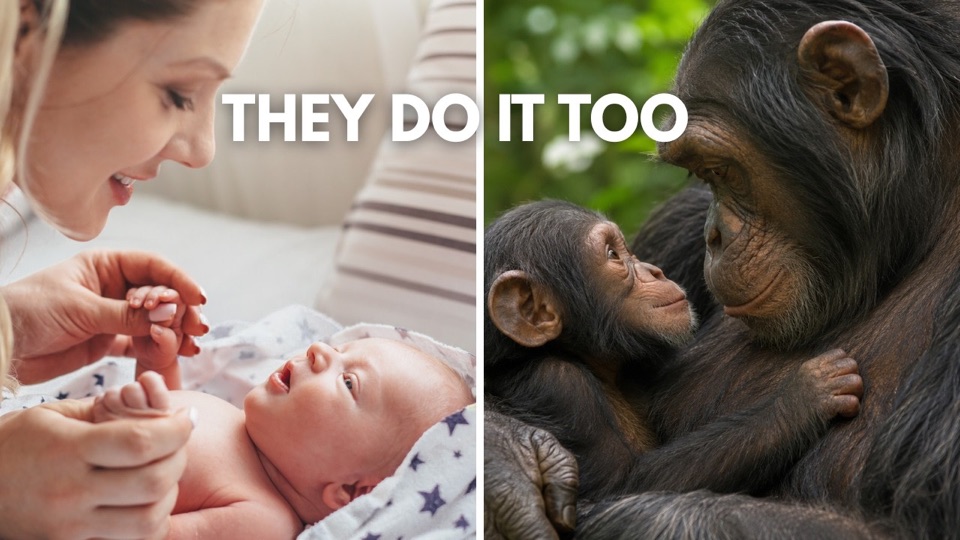
Researchers recorded nearly 4,000 bouts of adult play in wild chimpanzees over ten years. When good food ran short, adult play fell almost to zero, apart from mothers, who carried on because their young had nobody else.

Watch the video: What 4,000 Chimpanzee Play Fights Tell Us About Being a Mum · Subscribe to Mum Science
Researchers watched the same community of wild chimpanzees for ten years. When food got scarce, the grown-ups almost completely stopped playing. Apart from one group: the mothers, who kept playing with their own youngsters because nobody else was left to do it.
The authors call this a hidden cost of motherhood, and I haven't stopped thinking about it since I read the paper. Partly because I love a primate study, and partly because I suspect a lot of mums will recognise the pattern before I've even finished explaining it.
What did the chimp study actually look at?
The study was published in Current Biology in 2024, led by Kris Sabbi, using data from the Kibale Chimpanzee Project in Kibale National Park, Uganda. That's ten years of watching the same community of wild chimpanzees, and over that time the team recorded nearly 4,000 separate bouts of adult play.
That number is more remarkable than it sounds, because adult play is rare in animals. Most species play when they're young and then stop. The usual explanation is that play is for development: it builds the skills you need, and once you've got them, it isn't much use to you any more.
This team had a different idea. Perhaps adults would quite like to play, but usually can't afford to. So they tracked play against diet quality, which here meant how much high-quality fruit the chimps were getting, across those ten years.
Why is play such a good measure of spare energy?
Play uses up energy and time, and it doesn't feed you. For a wild animal on a tight budget, that makes it one of the first things to go. Which, as it happens, makes it a rather good way of measuring how much spare capacity an animal actually has. If an adult chimp is wrestling and play-fighting, it has energy to burn. If it has stopped, it probably hasn't.
It also means play is a sort of luxury good, and a costly one. Every bout spent rolling around with a youngster is energy that isn't going on finding food, travelling or keeping yourself going.
What happened when food ran short?
When there was plenty of good fruit around, the adults played, with each other and with the youngsters. But as the food got poorer, adult play dropped to almost nothing. So play isn't pointless for grown-ups after all. The authors suggest adults play when they have the energy or time to spare, and that it keeps some social value beyond childhood. It's just expensive, so they ration it.
But one kind of play carried on. When diet quality dropped and everybody else's play fell away, mothers kept playing with their own offspring.
The authors' interpretation is that young chimpanzees need to play, because that's how they develop. When food is poor, mothers spend less time around other chimps, so their youngsters have fewer playmates, and other adults play far less. The mother becomes the main play partner left, so she picks up the slack. She ends up paying an energy cost at exactly the moment when energy is hardest to come by, because her child still needs something and nobody else is providing it.
That's why it's hidden. If you only counted calories eaten or time spent feeding the infant, you'd never see it. The cost only shows up when you look at something as easy to overlook as play.
The honest limitations
This is an observational study, so nobody changed anything on purpose. You can't exactly ration a forest. It's a pattern spotted over ten years rather than an experiment, and because diet changes with the seasons, other things change alongside it too. Any of those could be playing a part.
It's also one community of chimps in one forest. Chimp societies vary a lot from place to place, and so does the food. I'd want to see the same pattern at another field site before treating it as true of chimpanzees in general, never mind us.
What's genuinely strong is the length of it. These are the same animals, watched for a decade by people who know each one individually. You can't get that from a two-year university grant, and it's exactly why long-term field sites matter. Fair play to them (sorry, I couldn't resist).
Does this tell us anything about human mums?
I want to be careful here, because this part is my framing, not the paper's finding. I heard a primate expert on Radio 4 recently talking about how we tend to look at chimpanzees through human-shaped goggles, searching for ourselves in their behaviour rather than accepting that some of it is just chimp. That's worth keeping in mind.
Still, the pattern in these chimps is simple. When resources get tight, the wider group stops contributing first. The mother keeps going, because her child still needs it. So the gap ends up with one individual, quietly, and it doesn't show up in any of the things you'd normally measure.
If that sounds familiar, I think it's because families can go the same way when they get squeezed. When money is tight or time is short, people get stressed, and stressed people play less. The person absorbing all of it is usually the last line, not the first, which is exactly why it's so easy for everyone else to miss. Chimps aren't us, and the authors aren't claiming otherwise, but it's a clean picture of a cost that's normally invisible.
What this means for your family
There's nothing you need to do differently after reading this, which I quite like. But if you're still the one on the floor at the end of a week when everything else has gone, it might help to know that the same pattern shows up in a species that isn't even ours.
And if you've had weeks where you ran out of play completely, please don't hear this as a telling-off. The whole point of the paper is that play costs something, even for a chimp. Children do need it, and it's one of the main ways young children learn, but needing it doesn't make it free for the person providing it. That goes for dads too. Our children rely on us to put a smile on, read the book and play the game, even when we're running on empty.
For anyone around a mum who is absorbing the slack, the lesson from the chimps is practical. What helps is being another play partner yourself, so she isn't the only one, rather than offering advice or explaining how you managed it in your day. Get down on the floor. Take a turn.
And if you want the short version for your partner or a friend: when times got hard, wild chimps all stopped playing apart from the mothers, and they kept going because their kids had nobody else.
Questions parents ask
Do adult animals play?
Rarely. In most species, play is mainly something the young do. Wild chimpanzees are an exception: over ten years in Kibale National Park, Uganda, researchers recorded nearly 4,000 bouts of adult play. The adults played much more when good fruit was plentiful, which suggests grown-ups still value play but only do it when they can afford the energy.
Why do chimpanzee mothers keep playing with their young when food is scarce?
The researchers think it is because young chimps need play to develop, and when food runs short most other adult play falls to near zero, and mothers spend less time around other chimps, so their young have fewer playmates. That leaves the mother as the only partner. She keeps playing even though it costs her energy at the worst possible time, which is why the authors call it a hidden cost of motherhood.
What does 'hidden cost of motherhood' mean in this study?
It is the authors' phrase for the extra energy chimp mothers spend playing with their offspring when food is scarce and nobody else will. My reading is that it is hidden because ordinary measures, such as calories eaten or time spent feeding an infant, would not pick it up. It only shows when you track something easy to overlook, like play.
Can chimpanzee research tell us about human mothers?
Only loosely. Chimpanzees are close relatives, so their behaviour can raise useful questions, but this was one community at one site, and the study did not look at humans at all. Any parallel with human family life is an interpretation, not a finding. It is best read as a clear picture of a cost that is usually invisible.
References
- Sabbi, K. H., Kurilla, S. E., Monroe, I. G., Zhang, Y., Menante, A., Cole, M. F., Otali, E., Kobusingye, M., Emery Thompson, M., Muller, M. N., Wrangham, R. W., & Machanda, Z. P. (2024). Ecological variation in adult social play reveals a hidden cost of motherhood for wild chimpanzees. Current Biology, 34(6), 1364–1369. doi.org/10.1016/j.cub.2024.02.025