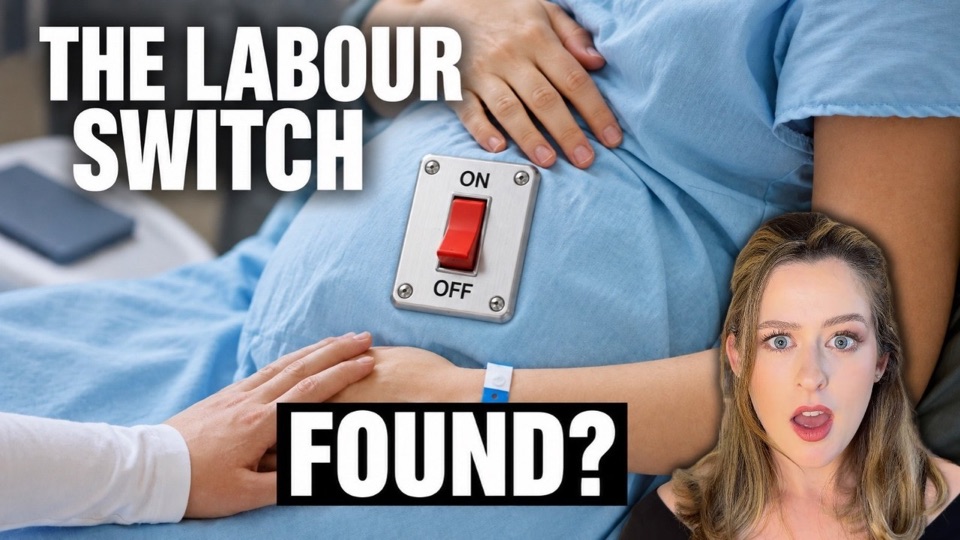
Hypnobirthing: the physiology behind how it might help
It's not mystical. It's the feedback loop between fear, adrenaline, and pain — and understanding it changes everything about how you prepare for birth.

When I first heard the word "hypnobirthing" I pictured something vaguely mystical and probably not for me. But the more I read about it, the more I realised it wasn't mystical at all. It was physiology.
The fear-tension-pain cycle
Dr Grantly Dick-Read, a British obstetrician, described what he called the fear-tension-pain cycle: when a labouring person is frightened, their body produces adrenaline. Adrenaline is a fight-or-flight hormone — in a genuine emergency it's lifesaving. In labour, it works against the process. It causes the circular muscles of the uterus to contract protectively while simultaneously inhibiting the longitudinal muscles that are supposed to be driving labour. The result is a uterus working against itself: more effort, less progress, more pain, more fear.
Oxytocin and the parasympathetic nervous system
Labour is primarily driven by oxytocin. Oxytocin is produced most readily when a person feels safe, warm, private, and unhurried. It is suppressed by stress, bright lights, observation, and unfamiliar environments — all of which describe a standard clinical setting. Hypnobirthing techniques — slow breathing, guided relaxation, and visualisation — activate the parasympathetic nervous system and create the internal conditions for oxytocin to flow. The idea that stress hormones can slow labour is well described in reviews of birth physiology, but the Cochrane reviews of hypnosis and relaxation looked at things like pain and pain relief, not hormones, so whether these techniques actually boost oxytocin in labour hasn't been shown.
What the evidence shows
A 2018 Cochrane review of relaxation techniques in labour found some evidence that relaxation lowered pain in early labour and improved women's satisfaction with their pain relief, but no clear difference in how satisfied they felt with the birth overall, and the evidence was rated low to very low quality. A 2016 Cochrane review by Madden and colleagues pooled nine trials of 2,954 women, mostly antenatal hypnosis classes, and found that women in the hypnosis groups were less likely to use drug-based pain relief. That evidence was also rated very low quality, and there were no clear differences in most other outcomes, so hypnobirthing is best seen as a tool that helps some women, not a guarantee.
Tiered birth plans
One of the most practically useful things I took from hypnobirthing preparation was the idea of tiered birth plans: a dream scenario, an acceptable scenario, and a worst-case scenario. Not to catastrophise — but to feel genuinely informed whatever direction labour takes. When you understand your options, you make decisions from knowledge rather than fear. And that changes everything.
References
- Dick-Read, G. (1944). Childbirth without fear: The principles and practice of natural childbirth. Harper & Brothers.
- Madden, K., Middleton, P., Cyna, A. M., Matthewson, M., & Jones, L. (2016). Hypnosis for pain management during labour and childbirth. Cochrane Database of Systematic Reviews, (5), CD009356. doi.org/10.1002/14651858.CD009356.pub3
- Smith, C. A., Levett, K. M., Collins, C. T., Armour, M., Dahlen, H. G., & Suganuma, M. (2018). Relaxation techniques for pain management in labour. Cochrane Database of Systematic Reviews, (3), CD009514. doi.org/10.1002/14651858.CD009514.pub2
- Uvnäs-Moberg, K. (2003). The oxytocin factor: Tapping the hormone of calm, love, and healing. Da Capo Press.
- Buckley, S.J. (2015). Hormonal physiology of childbearing. Childbirth Connection Programs, National Partnership for Women & Families.