Chemicals in disposable nappies: what testing 31 products actually found
Researchers tested 31 disposable nappies and wipes for 98 volatile chemicals. Every product had trace levels, including benzene in baby nappies, but the most useful finding was that ‘organic’ and ‘sensitive’ labels didn't mean fewer chemicals.

Watch the video: What's Actually In Disposable Nappies? Scientists Tested 31 Products · Subscribe to Mum Science
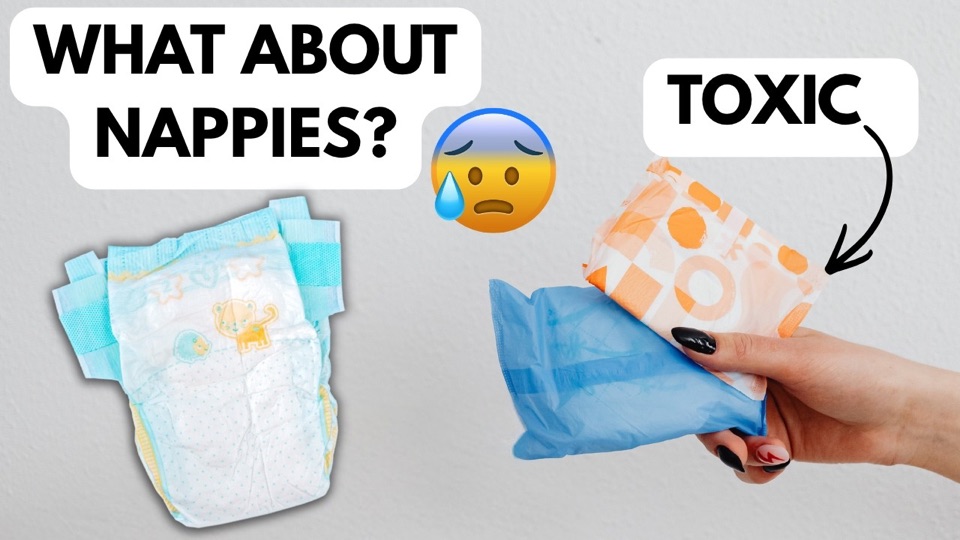
My video asking whether disposable nappies are toxic got more comments per view than anything else I've made, and almost all of them said the same thing: this needs a proper deep dive. So here is the study that actually put nappies in a lab. Thirty-one products, 98 chemicals tested for, and one finding that might change how you shop, though perhaps not in the direction you'd expect.
It also comes with a phrase, ‘benzene in nappies’, that is exactly the sort of thing that gets screenshotted without the rest of the sentence. So let's look at the whole sentence.
What did the nappy study actually test?
The paper was published in 2023 in Environmental Science & Technology, the flagship journal of the American Chemical Society, by Nan Lin, Ning Ding and colleagues at the University of Michigan. They bought 31 disposable hygiene products from the US market, including baby nappies, adult nappies and baby wipes, choosing them by market share so they would reflect what people actually buy. They then analysed each one for 98 volatile organic compounds using purge-and-trap sampling with gas chromatography and mass spectrometry, which is proper analytical chemistry.
Finally, they modelled how much of these chemicals a person might absorb, and what the health risk might be, under what they called reasonable upper-level exposure scenarios. The authors point out that the levels and health risks of these compounds in nappies had never been reported before. This was the first look.
What are VOCs, and why do they matter in a nappy?
Volatile organic compounds, or VOCs, are carbon-based chemicals that evaporate easily at room temperature. That new car smell, fresh paint, the smell when you open a new packet of nappies: those are VOCs. Some are harmless, some are irritants, and a few are classified as carcinogens.
They matter here because of where a nappy sits. It's against thin, permeable skin, in a warm, enclosed and often damp environment, for hours a day, for a couple of years or more. That is a fairly efficient set-up for absorption, which is why it's a reasonable thing to study.
What did they find in disposable nappies?
Toxic VOCs were found in all the nappies and wipes tested, but at trace levels. You need both halves of that sentence.
- Adult nappies had the highest levels overall, mostly alkanes, with a median total of 23.5 micrograms per gram. In some adult products, the modelled non-cancer risk came out very large, driven by a single solvent called n-heptane.
- Baby nappies contained several known or suspected carcinogens, including benzene and 1,4-dioxane. The modelled lifetime cancer risk from some baby nappies approached one in a million, under a worst-case scenario.
- Labels didn't help. Store-brand products tended to have higher VOC levels than big-name brands, though only one store-brand nappy and one store-brand wipe were tested, and products labelled ‘organic’ or ‘for sensitive skin’ did not necessarily have lower levels.
That last point is the one I'd take away. On this evidence, the premium label was no reliable guide to lower levels of these chemicals, although only a handful of labelled products were tested.
How worried should parents be?
Let me put the numbers in proportion. A one-in-a-million lifetime cancer risk is a regulatory threshold, not a prediction about your child. It's roughly the level at which environmental agencies say ‘we should look at this’. It is vastly smaller than everyday risks none of us organise our lives around, and it was only approached in some baby nappies, under a worst-case model. The paper's most eye-catching risk number applies to adult nappies, not baby ones. If you remember one caveat, make it that one.
The limitations are worth spelling out plainly. These are modelled exposures, not measured ones: nobody swabbed a baby or tested a child's blood. The researchers estimated how much would move from the product into the skin and the body under a set of assumptions, and if you change the assumptions, the numbers change. It was 31 products from the US market, and brands and formulations differ between countries, so it doesn't directly tell us about UK nappies. It was a one-off snapshot of products on the shelf at the time. And it didn't test cloth nappies at all. In its favour, it was the first study of its kind, it used rigorous chemistry, it sampled by market share rather than convenience, and it reported findings about premium labelling that no manufacturer would have wanted published.
Where do the chemicals come from, and are cloth nappies better?
Some of these compounds are likely to be leftover solvents from manufacturing: the adhesives, the elastics and the processing of the absorbent core. Some come from fragrances and inks. Some are contaminants in raw materials. That's probably why ‘organic’ branding doesn't help: the label is about where the fibre comes from, not the residual solvents picked up during assembly.
The authors' recommendation is aimed at manufacturers rather than parents: eliminate and monitor toxic ingredients, and disclose all the chemicals that may be in these products. To me, that's the real story. As things stand, parents can't easily find out everything that's in a nappy.
Many of you asked about cloth, including synthetic fibres, microplastic shedding and pesticide residues in cotton. I use cloth myself, and I looked. The honest answer is that this kind of research on cloth nappies barely exists. You may well be right that cloth is better, and logically it makes sense to me, but it hasn't been demonstrated, and I won't tell you it has. That's a genuine gap, and one I'd love to see researchers fill.
What this means for your baby
If your baby is in disposables, this study doesn't give you a reason to panic or to change anything today. Trace levels, modelled worst cases and a regulatory threshold that some products only approached. Families choose disposables for very real reasons, and nothing here should make you feel guilty about that.
If you'd like to reduce exposure anyway, the practical options are unglamorous and mostly free. These are sensible suggestions based on how VOCs behave, not things the study tested:
- Air them out. Open a new packet and let it sit before use. VOCs are volatile, which means they evaporate.
- Change nappies promptly, since warmth and moisture increase absorption.
- Give some nappy-free time. I pop my one-year-old on the potty when I think she might need to go, like after she wakes up or after meals. It also means some time out of a nappy altogether.
- Skip fragranced nappies and wipes, one of the few clearly avoidable sources.
What I'd stop doing is paying extra for ‘organic’ or ‘sensitive’ on the assumption that it means fewer chemicals. On this evidence, it doesn't reliably. Buy them if they suit your baby's skin, not because you think you've bought a cleaner product. Labels on baby products carry a lot of emotional weight, something I've also written about in what a warning label on a formula tin does to mothers.
And if your baby has nappy rash that isn't clearing, that's a conversation for your health visitor or GP, not a chemistry question.
Questions parents ask
Are organic or sensitive skin nappies safer?
Not in terms of volatile chemicals, on current evidence. In a 2023 study of 31 US products, nappies labelled ‘organic’ or ‘for sensitive skin’ did not necessarily contain lower levels of VOCs. The organic label usually describes where the fibre comes from, not solvents picked up during manufacturing. If a particular brand suits your baby's skin, that's still a perfectly good reason to use it.
Do baby nappies contain benzene?
Trace amounts were found in some. A University of Michigan study detected benzene and 1,4-dioxane in baby nappies, and modelled lifetime cancer risk from some products approached one in a million under a worst-case scenario. That figure is a regulatory threshold for further attention, not a prediction about any child, and exposure was estimated with a model rather than measured in babies.
Are cloth nappies safer than disposables?
Nobody knows yet. The 2023 nappy chemicals study didn't test cloth nappies, and equivalent research on cloth, including synthetic fibres, microplastics or pesticide residues in cotton, barely exists. Cloth may well turn out to mean lower exposure, but it hasn't been demonstrated. Both are reasonable choices, and the best nappy is the one that works for your baby and your family.
Should I air out disposable nappies before using them?
It's a sensible, free step if you want to reduce exposure. VOCs evaporate easily at room temperature, so opening a new packet and letting it sit for a while should let some disperse. The study didn't test this directly, so treat it as a reasonable precaution rather than a proven fix. Choosing fragrance-free nappies and wipes is another easy option.
References
- Lin, N., Ding, N., Meza-Wilson, E., Devasurendra, A. M., Godwin, C., Park, S. K., & Batterman, S. (2023). Volatile organic compounds in disposable diapers and baby wipes in the US: A survey of products and health risks. Environmental Science & Technology, 57(37), 13732–13743. doi.org/10.1021/acs.est.3c02862